

David Bellamy
MWT Glion Darragh Reserve
A valley where conifer plantations are becoming ‘refarmed’ to become a resilient, diverse Manx rainforest
Glion Darragh is a 170-acre valley in West Baldwin, now in the long-term care of Manx Wildlife Trust and managed for nature recovery and public benefit. Once a commercial conifer plantation, the valley is now undergoing major restoration as part of the wider Manx Rainforest initiative, supported through a long-term partnership with Aviva under The Wildlife Trusts’ Temperate Rainforest Restoration Programme. The aim is to create a resilient landscape combining native woodland, diverse habitats and restored peatlands.
- Restoring a former conifer plantation into a mixed native woodland–pasture Manx Rainforest landscape.
- Low-intensity cattle grazing, strategic conifer removal, underplanting and peat re-wetting for long-term regeneration.
- Creating a varied Manx Rainforest mosaic of woodland, scrub, pasture and wetland with an emerging native canopy.
- Providing rich habitat for fungi, invertebrates, bryophytes, woodland birds and other specialist wildlife.
- Species abundance, stronger climate resilience, reduced downstream flood risk and improved water quality.
- A quiet place for leisure, wellbeing, learning and heritage, and the revival of a rare and special ecosystem.
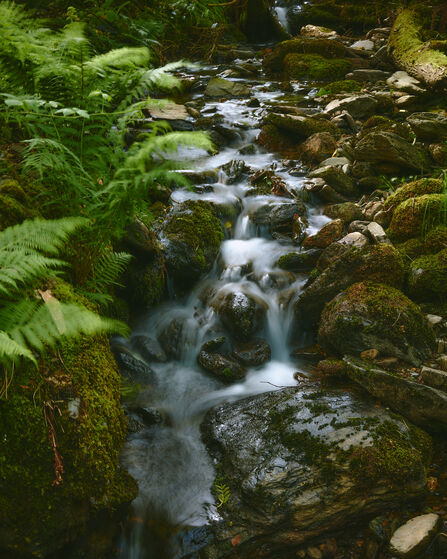
Stream at Glion Darragh by Adam Morgan and Ciara Hardisty, Biosphere Photographers in Residence
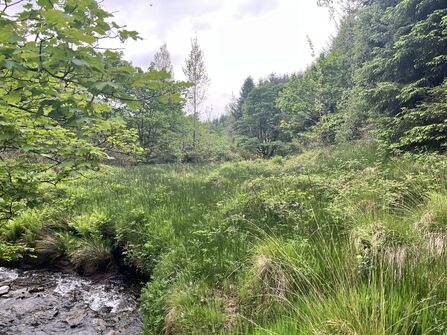
Stream and habitat mosaic going into conifer plantation at Glion Darragh

Rich moss-covered at Glion Darragh shows the perfect suitability of the reserve for temperate rainforest.

Grassland at Glion Darragh
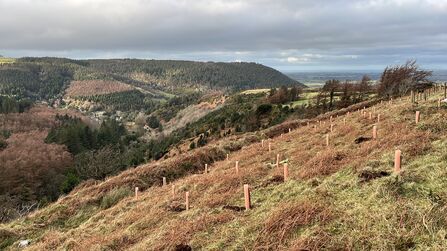
Hillside tree planting at Glion Darragh
Restoration Approach and Long-Term Vision
The former plantation is dominated by tall, uniform conifers planted in the late 1980s. Instead of large-scale clear-felling, MWT is applying a phased approach to gradually convert the site into a more diverse and resilient forest.

(c) MWT - plantation conifers toppled in a single night by Storm Darragh, highlighting the vulnerability of monoculture plantations where tree of one species and all of the same age dominate a landscape.
Storm Darragh brought this challenge into sharp focus, toppling c. 5000 mature conifers in a single night, disrupting the planned, phased restoration approach. The storm-damage accelerated canopy openings in places, requiring additional management. It also provided great opportunities, creating tip mounds of soil and rewilding the contours of the site with thousands of mini-wetlands and dry mounds, speeding up some elements of the transition towards native woodland.
Many conifers are being strategically ring-barked and left standing to die slowly. This method provides ecological deadwood, reduces windthrow risk in neighbouring trees, and gradually opens the canopy. As light reaches the forest floor, MWT will under-plant native trees — including oak, birch, hazel, willow and holly — which will form the emerging Manx Rainforest canopy.
Historic field boundaries will be reinstated as hedgerows, and low-intensity grazing will eventually be reintroduced to create a woodland-pasture landscape. On the slopes, removal of drains and peatland re-wetting will restore hydrology and encourage the recovery of peat-forming vegetation.
Over time, Glion Darragh will transition from a single-age conifer block to a vibrant mosaic of native woodland, open glades, scrub, meadow and wetland — a structurally complex landscape more typical of natural rainforests in the British Isles.
Habitat Recovery and Biodiversity
Restoration will benefit wildlife as soon as light and structure begin to change.
- Ground flora and shrubs will return as the canopy thins.
- Standing deadwood will support fungi, invertebrates and cavity-nesting birds.
- Humid microclimates near streams and ravines will help bryophytes, liverworts and lichens flourish — species that characterise temperate rainforest systems.
- Overlooking the site is the rocky ‘Creg’, which will be planted with scrubby Juniper and Rowan – a perfect eagles’ nest.
- Peatland recovery will support upland insects, wetland plants and improved soil carbon.
- Birds will benefit as woodland complexity increases, offering nesting sites, food, shelter and foraging across a range of habitats.
The combination of woodland, pasture, scrub and peatland makes Glion Darragh a valuable future site for biodiversity.
Benefits for People and the Island
Restoring Glion Darragh brings long-term benefits beyond ecology:
- Nature recovery and biodiversity gain — a resilient, nature-rich landscape for future generations.
- Climate resilience and carbon storage — expanding native woodland and restoring peat captures carbon, improves soil health and contributes to climate mitigation.
- Flood mitigation and hydrological stability — woodland and peat slow water flow, reduce erosion and protect downstream communities.
- Wellbeing and educational value — a quiet valley suited to low-impact activities, volunteering, learning and restorative time in nature.
- Cultural heritage — historic field systems, old farm sites and traces of rural life will be protected and interpreted.
- Sustainable land use — grazing, woodland and restored habitats together form a multifunctional landscape aligning conservation with rural livelihoods.
What Glion Darragh Will Become
Over the next 10–20 years, Glion Darragh will gradually adopt the structure of a young Manx Rainforest: varied canopy heights, a developing understory, moss-rich damp hollows and diverse woodland margins. By the 2040s, this secret valley will be a farm again. Conservation grazing will have begun on the lower slopes. By mid-century, it will form an important part of the Island’s developing Manx Rainforest network.
Our Partners
Manx Rainforest restoration is possible thanks to the hard work and partnership of many individuals, communities, organisations and businesses. In particular, thanks to our long-term project partners:

Partner Logos: Isle of Man Woodland trust, Aviva, The Wildlife Trusts, The Milntown Estate and Gardens
Read more

(c) Adam Morgan and Ciara Hardisty, Biosphere Photographers in Residence
Visit MWT Glion Darragh Reserve
Read more
Leigh Morris
"Glion Darragh - Rainforest and Re-Farming"
Read more
(c) Adam Morgan and Ciara Hardisty, Biosphere Photographers in Residence